Curriculum Statement
Curriculum Statement : Knowing more…..remembering more…..connecting learning
Intent
Our curriculum is designed to meet the rapidly changing times in which we live and to develop global citizens with a responsibility for the future of the planet. Embedded within the curriculum are the United Nations 2030 sustainability goals. It will equip our pupils to critically and actively engage with the challenges, opportunities and responsibilities of life in a fast changing and interdependent world.
Our curriculum motivates, identifies and develops the hidden talents of all our pupils, and enables them to take ownership of their learning. It is planned and sequenced so that new knowledge (substantive knowledge) and skills (disciplinary knowledge) build on what has been taught before and towards clearly defined end points. Our curriculum is broad and balanced and gives priority to all subject disciplines
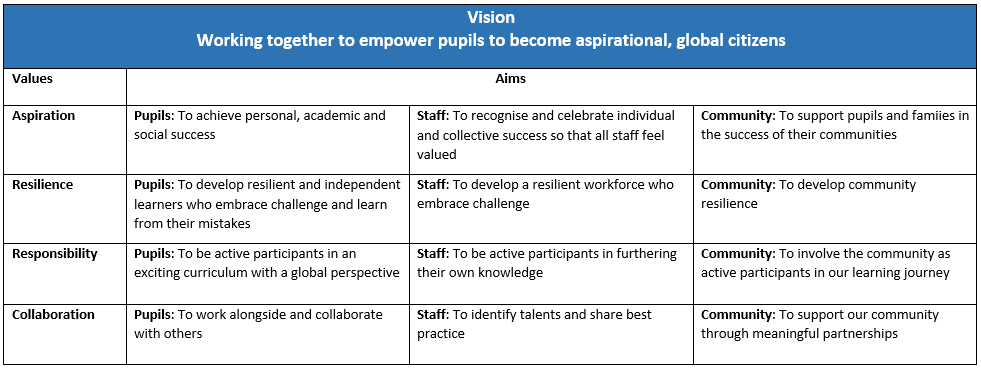
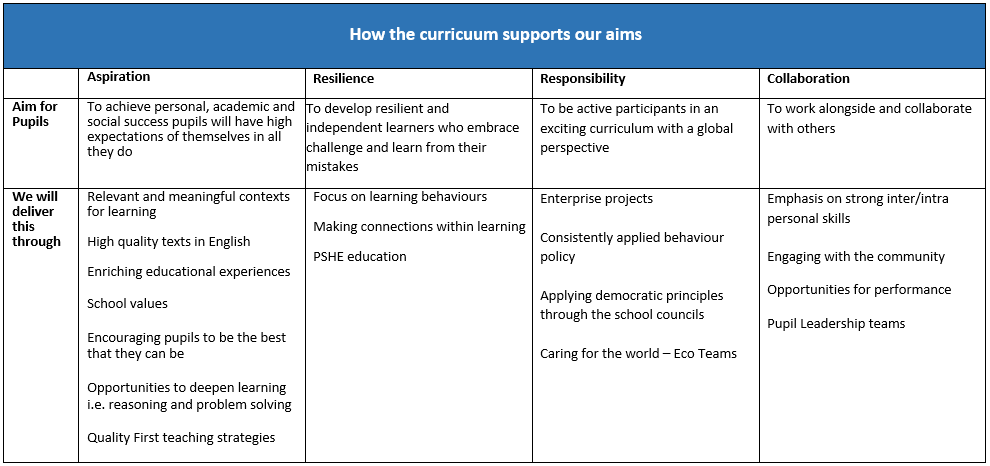
Our values of Aspiration, Resilience, Responsibility and Collaboration drive our curriculum and are intrinsic to our aims for the federation.
Implementation
Our curriculum design is based on the knowledge that:
- Learning is most effective with spaced repetition.
- Retrieval of previously learned content is frequent and regular, which increases both storage and retrieval strength.
We also understand that learning is hard to see in the short term and that sustained mastery takes time. Each theme begins with an exciting day to immerse pupils into the subject followed by an opportunity for an assessment of prior knowledge and skills.
Each subject within the curriculum has a further subject-specific rationale which demonstrates the why, what and how of learning in the subject and the order in which we teach this so that pupils make progress.
In all subjects this begins with knowledge, consisting of
- Substantive knowledge: The specific, factual content for the subject its associated vocabulary, which are connected onto a careful sequence.
- Disciplinary knowledge: The way we gain substantive knowledge, what is commonly thought of as the subject specific skills – the “know-how” – of each subject.
Research shows that careful integration of subjects leads to deeper learning. As subjects influence each other, it is useful to present knowledge in an interconnected way, reflecting the complexities of the world in which we live. Our wider curriculum is therefore organised into ‘Big Ideas’ where knowledge is interwoven and built over time and developmentally appropriate to age and stage.
How does learning in the Early Years Foundation Stage provide the range of experiences and a secure knowledge base, on which the KS1 curriculum builds?
The Early Years is the start of pupils’s journey to becoming aspirational global citizens. In both the outdoor and indoor environments, we provide pupils with opportunities to develop the characteristics of effective learning in EYFS: playing and exploring, active learning and creating and thinking critically. We deliver our curriculum through a balance of adult led and child-initiated activities based on the EYFS Framework 21’ & pupils’s interests which ensure that learning is fun, engaging and challenges and supports all pupils whatever their starting point.
Our progression model for each subject then builds on the foundations established at this stage.
Our Curriculum Years 1-6
Connecting concepts in different subjects across the curriculum, where appropriate, enables our pupils to make connections and remember what they have learnt more easily.
Our History, Geography and Science units are closely connected to our English curriculum. Well-chosen high-quality texts, used in the development of English, connect to our chosen units of study. For example, Year 6: The Island (Armin Greder) links to the History/Geography unit ‘What is a home?’ during which pupils study the concepts of migration, settlement, invaders, and mobilisation, and supports our global dimension. This enables us to develop pupils writing, their substantive knowledge (facts and information) and disciplinary/procedural knowledge (enquiry skills and interpretation of evidence etc.) and make meaningful links across subjects.
Other subjects such as Art often naturally align and pupils study art linked to the unit of study. For example, in Y6 during the unit ‘What is a home, pupils explore abstract artists such as Artist: Wassily Kandinsky, Joan Miro, Sculpture – Isamu Noguchi, Alberto Giacometti. They sketch abstract ideas based on what ‘home’ is and use these to design and form an abstract 3D construction to symbolise an individual’s home, allowing for creative, innovative and personal ideas. In music they are given the opportunity to they think about ‘How Does Music Shape Our Way of Life?’ and ‘How music can bring us together’
We believe our Contexts for Learning provide learning experiences that are both richer and deeper and support pupils in making learning more memorable. However, whilst these Contexts for Learning support pupils in making connections and knowing and remembering more, the focus is on the accumulation of knowledge and skills relevant to each subject discipline.
However, our connections are never tenuous. Some subjects are taught in isolation if this is the best way to ensure that the pupils know more, remember more and deepen their learning. We expect our pupils to talk confidently about prior learning and connect learning and concepts in each subject.
We are very aware that South Gloucestershire is not a hugely diverse county (in terms of race and religion) and we we have a responsibility to respond to this by exposing pupils to difference in its many forms. Our Vision and aims ensure that from a very young age, are developing the skills of tolerance, empathy, understanding and cultural appreciation that is then built upon through the wider curriculum including MfL, RE and PSHE in KS2. This supports the personal development of pupils as well as their Spiritual, Moral, Social and Cultural development and also aligns with our underlying extended curriculum emphasis on the UN sustainable goals.
All curriculum areas are led by a team of staff from across the federation and where possible with experience in KS1 and KS2 (and in some case EYFS). These leadership teams work together to monitor, review and evaluate their subject to ensure we equip pupils with the knowledge and cultural capital they need to make good or better progress and be fully prepared for the next stage of their education.
Our curriculum is made explicit through the following documentation:
- Our long-term subject specific curriculum overviews which include:
- The ‘Big Question’ i.e. the contexts within which the learning takes place
- The termly theme planners for each year group which include
- The key objectives that we want pupils to learn within the unit of study organised into smaller ‘Learning questions’
- The ‘Golden Nuggets’ key substantive knowledge/disciplinary knowledge that we want the pupils to know and remember at the end of the unit of study
- Other links e.g. to Sustainable development Goals, links to other curriculum areas
- Key vocabulary that pupils should learn during the unit.